Our product rankings are based on analysis of thousands of customer reviews, brand reputation, pricing trends, and popularity data. They represent our honest opinion and are intended as a helpful starting point for your research. Some links on this site are affiliate links — if you buy through them, we may earn a small commission at no extra cost to you. This helps us keep the site free and up to date.
An office diffuser brings a light, pleasant scent to your working day, whether that is a small unit on your own desk or a scent machine covering a reception, meeting room or open-plan floor. This range is for home workers, small businesses and office managers who want a tidy, quiet way to scent a workspace without candles or aerosol sprays.
Below you'll find desk-sized diffusers and larger office scent machines side by side. For a cable-free desk option, see our battery operated diffusers; to scent a whole building, compare a commercial scent machine.

An office diffuser is any device that releases fragrance into a workspace. At one end it is a small reed or ultrasonic unit that scents the area around your own desk. At the other it is an office scent machine that turns pure oil into a fine, dry vapour and spreads it through a reception, corridor or open-plan floor on a timed cycle.
The right choice depends on one question: is the scent just for you, or for everyone in the room? A personal desk diffuser and a whole-office system are bought, set up and managed in very different ways, so this guide covers both.
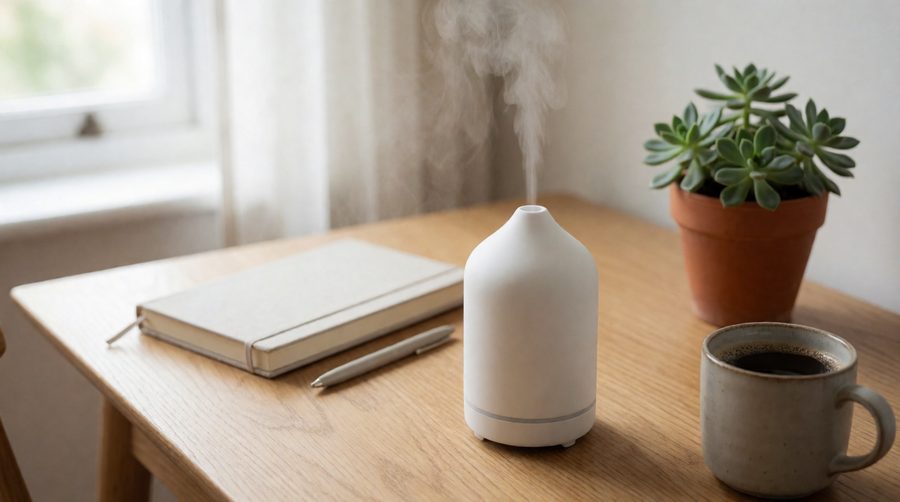
| Personal desk diffuser | Office scent machine | |
|---|---|---|
| Who it's for | You, at your own desk or in a home office | Staff and visitors in a shared space |
| Typical coverage | About 20 sq ft (a desk) up to a small room | 1,000 to 4,000+ sq ft (about 90 to 370 m²) |
| Main types | Reed, USB ultrasonic, battery or waterless mini | Waterless cold air (nebulising), floor-standing, ducted |
| Power | None, USB or rechargeable battery | Mains plug |
| Control | On/off button, simple timer | Schedules, intensity and cycles via panel or app |
| Upkeep | Refill water or oil, wipe clean | Swap or top up the oil bottle every few weeks |
| Who decides | You, after a word with the people near you | The office manager or business owner |
If you are scenting a reception, showroom or a whole floor, a commercial scent machine is the better tool. If you only want a pleasant smell at your own workstation, keep it small and local.
Rattan or fibre reeds draw fragranced oil up from a bottle and release it slowly. There is no power, no noise and nothing to switch on or off, which makes them the least intrusive desk option and the easiest one to get past a workplace electrical policy. The scent is gentle and stays close to the bottle.

A small water tank and a vibrating plate inside the diffuser turn water and a few drops of essential oil into a cool mist. They plug into a laptop or USB charger, run quietly and usually include a timer and auto shut-off. The drawback at work is water: keep them well away from laptops, keyboards and paperwork, and empty the tank at the end of the day.
Compact waterless diffusers draw neat oil from a bottle with no tank to spill. Many are rechargeable: Glamour UK's tester named the NEOM Wellbeing Pod Mini its best electric diffuser for home offices, noting its 50-hour battery and USB charging from a laptop. Our battery operated diffuser range covers cordless models, and the full choice of waterless diffusers includes mains versions too.
These are the workhorses of workplace scenting. A small air pump breaks pure oil into micro-fine particles with no heat or water, and a fan carries it across the room. They run in short bursts with long pauses, so a single bottle lasts weeks. Coverage ranges from a meeting room to a full floor.

For larger buildings, an HVAC scent diffuser connects to the ventilation or air-conditioning ductwork and spreads fragrance evenly through every room the system serves, with nothing on show. They need the building owner's permission and are best fitted by whoever looks after your ventilation.
A desk diffuser should be small, quiet and easy to live with. These points matter most:
If you want a diffuser for office use at home, you have more freedom. You set the strength, and a slightly larger ultrasonic or waterless unit can scent the whole room.
A business choosing an office scent diffuser is really choosing a scent system: the machine, the fragrance and the schedule. Get the sizing and settings right and the scent reads as a clean, welcoming background rather than an air freshener.
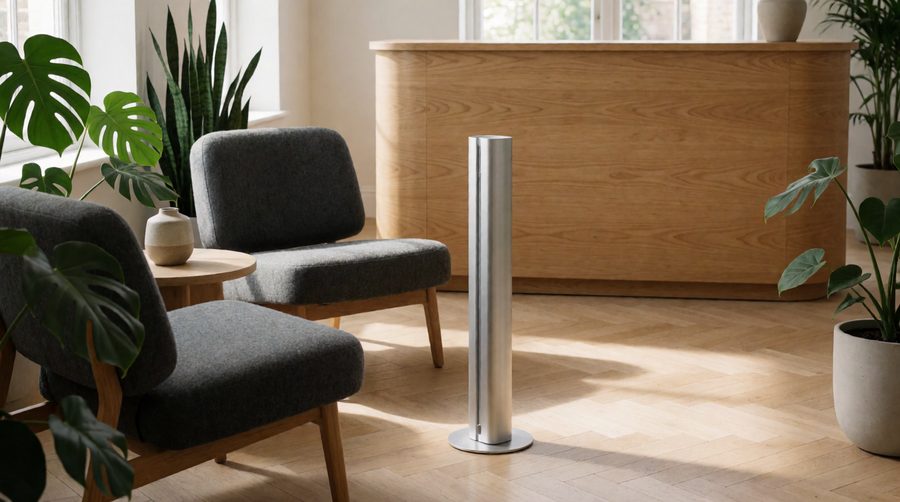
Work out the floor area in square feet or square metres (1 m² is roughly 10.8 sq ft), then pick a diffuser rated for that space or slightly above. A private office or meeting room usually needs a diffuser rated to around 1,000 sq ft; a reception or open-plan floor can need 2,000 to 4,000 sq ft. High ceilings, open stairwells and busy entrance doors all dilute scent. For large open areas, our large room diffusers list coverage clearly.
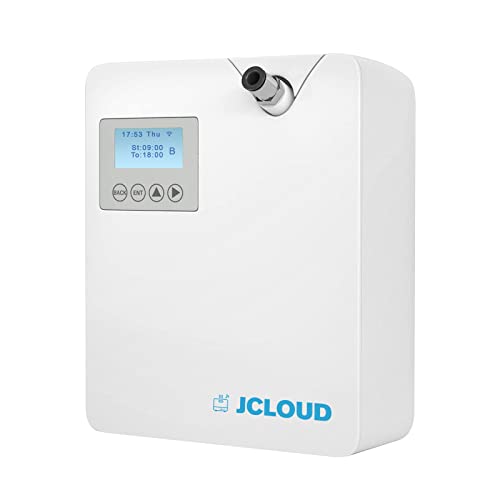
An office diffuser for a shared space works in bursts: a few seconds on, then a minute or two off. Start with the lowest intensity and longest pause, and only increase it if people genuinely can't notice it after a week. Schedule the diffuser to start shortly before staff arrive and switch off in the evening and at weekends. A smart diffuser lets you change all of this from a phone instead of crouching behind a desk.
Put the diffuser near the entrance or in a circulation area, where air moves, rather than next to a desk. Keep it off walkways and away from heaters and direct sun. In public areas, pick a model with a lockable bottle or locked controls so the settings aren't changed by visitors.
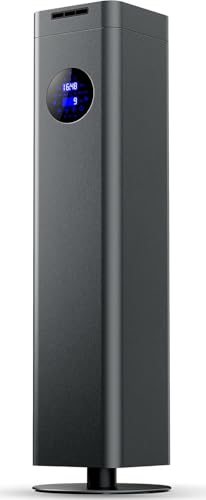
Hotels and shops use one consistent fragrance so the space feels recognisable; the same idea works in a reception. Our hotel scent diffusers show what that looks like in practice. For working areas, keep the scent lighter than you would in a lobby.
This is the part most buyers skip, and the reason many people dislike scent at work. You cannot keep fragrance inside your own desk area, and after a few minutes you stop noticing it yourself (nose-blindness), so you are the worst person to judge how strong it is.
Fragrance can cause real problems for some people. In Asthma + Lung UK research on indoor air, 4 in 10 people said aerosols and perfumes triggered their lung condition, and the charity notes that scented products release volatile organic compounds (VOCs) that can cause headaches and allergic reactions. Its advice on aromatherapy and essential oils says essential oils contain VOCs that can trigger symptoms in some people with asthma and other lung conditions.
A considerate approach for any shared workplace:
If you aren't sure, a reed diffuser on your own desk is the gentlest place to start.
A diffuser makes a room smell different, but it doesn't make the air fresher. Under the Workplace Regulations, employers must ventilate every enclosed workplace with a sufficient quantity of fresh or purified air, and HSE guidance on workplace ventilation says the fresh-air supply should not normally fall below 5 to 8 litres per second per occupant. If a room smells stale, fix the ventilation first; scent should never be used to hide a problem.
For plug-in units, the HSE answers on portable appliance testing confirm that annual PAT testing is not always necessary in low-risk environments such as offices, and that quick user checks are a useful part of keeping equipment safe. Look over the cable and plug before use, don't run cables across walkways, and switch the diffuser off when the building is empty.
Lighter, fresher fragrances suit working spaces best. Popular choices include:
Avoid heavy florals, vanilla and oud in shared workspaces; they carry further and are more likely to bother people. Our essential oil sets are a low-cost way to try a few scents before you commit to a signature fragrance. Note that many waterless diffusers need pure oils or the brand's own blends, so check before you buy.
Yes, as long as the people around you are happy with it and it's kept light. Check your workplace's policy, ask your neighbours, and switch it off straight away if anyone reports headaches or breathing problems.
A reed diffuser or a small waterless or USB diffuser with a timer. They're quiet, compact and keep the scent close to you. Avoid large ultrasonic models with big tanks next to electronics.
Match the coverage rating to the floor area: around 1,000 sq ft for a private office or meeting room, and 2,000 to 4,000 sq ft for a reception or open-plan floor. For multi-room buildings, consider a ducted HVAC system.
It depends on the bottle size, the intensity and the schedule. Jcloud, for example, quotes about 30 days from the 300ml bottle in its P300 on the highest setting, so lower settings and office-hours scheduling stretch it much further.
Ultrasonic and reed diffusers are close to silent. Waterless diffusers have a small air pump that gives a faint hum; one model in our range is rated below 40dB. Place larger diffusers in circulation areas rather than beside desks.
For some people, yes. Asthma + Lung UK says essential oils contain VOCs that can trigger symptoms, and recommends that people whose symptoms are triggered by strong scents avoid aromatherapy products. In a shared office, that's a good reason to ask first and keep scent light.
Ultrasonic diffusers do; reed and waterless diffusers, including most office scent machines, don't. Waterless designs are the tidier choice in a workplace because there is no tank to empty or spill.