Our product rankings are based on analysis of thousands of customer reviews, brand reputation, pricing trends, and popularity data. They represent our honest opinion and are intended as a helpful starting point for your research. Some links on this site are affiliate links — if you buy through them, we may earn a small commission at no extra cost to you. This helps us keep the site free and up to date.
A waterless diffuser is an electric unit that releases oil into the air without mixing it with water first. Instead of a tank and a vibrating plate, it uses a small air pump, an atomiser nozzle or a fan to break neat oil into particles fine enough to float around the room. Most screw straight onto a standard 10ml-20ml oil bottle or take a refillable reservoir of 100ml or more.
Because nothing dilutes the oil, the scent is fuller and more noticeable than from ultrasonic mist. There is no damp tank for bacteria to grow in, no limescale and no humidity added to the room. The trade-off is that a diffuser without water uses oil faster, so intensity and timer settings matter.
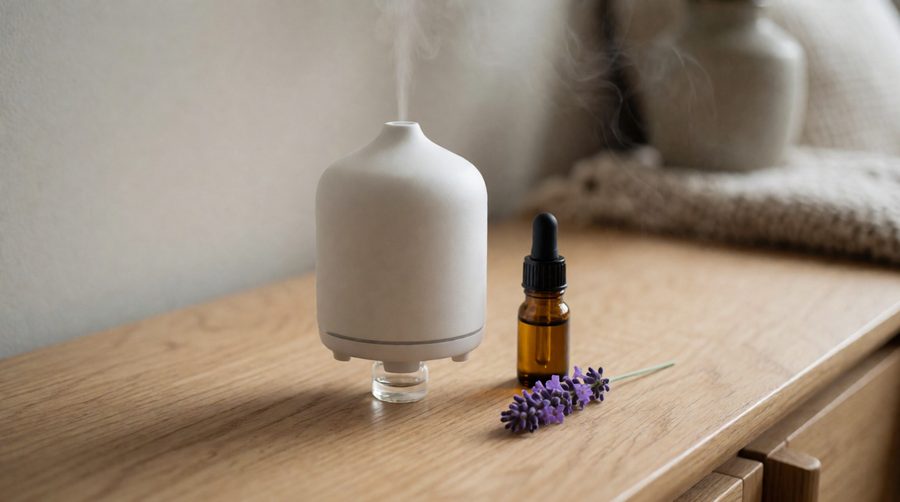
"Waterless" describes what the diffuser leaves out, not how it works. Four designs sit under the label, and they behave quite differently.
Fast-moving air from a pump passes over a narrow tube dipped in the oil. The drop in pressure draws oil up the tube, and the air stream shatters it into a fine vapour (the Bernoulli or venturi effect). Nebulisers give the strongest scent throw of any home design and work best with thin, pure essential oils. Many are small and rechargeable; see our nebulizing diffusers for travel-friendly models.
The technology behind most scent air machines and hotel lobby systems. A pump and a two-fluid atomiser create very small, dry particles that hang in the air for longer and leave no oily film on surfaces. They hold more oil, run on programmed on/off cycles and cover bigger spaces. Our cold air diffusers explain the technology in more detail.
Wall plug-in models and smart pods either use a small cold air atomiser or push air across a fragrance cartridge. They are cheap to run and tidy, but usually suit a single room.
Gently warm the oil so it evaporates. They are silent and simple, but heat can alter the more delicate notes of an essential oil, so most buyers now choose cold air or nebulising designs.
It depends on what you want from it. Here is how the two compare.
| Ultrasonic (water) | Waterless | |
|---|---|---|
| How it works | Vibrating plate turns water and a few drops of oil into mist | Air pressure or a fan atomises neat oil |
| Scent strength | Light to moderate, diluted by water | Strong and true to the oil |
| Oil use | Low - a few drops per fill | Higher - adjust with intensity and timers |
| Humidity | Adds a little moisture | None |
| Cleaning | Empty and wipe the tank often to stop residue and mould | Occasional nozzle clean, no tank |
| Visible mist | Yes, a soft plume | Little or none |
| Coverage | Usually one room | One room up to a whole house |
| Best for | Bedrooms, dry centrally heated rooms | Living rooms, offices, cars, anyone who hates cleaning tanks |
If you like the visible mist and want a touch of moisture in a dry bedroom, an ultrasonic model is fine. If you want the oil to do the work, with less upkeep and nothing to spill, waterless wins.
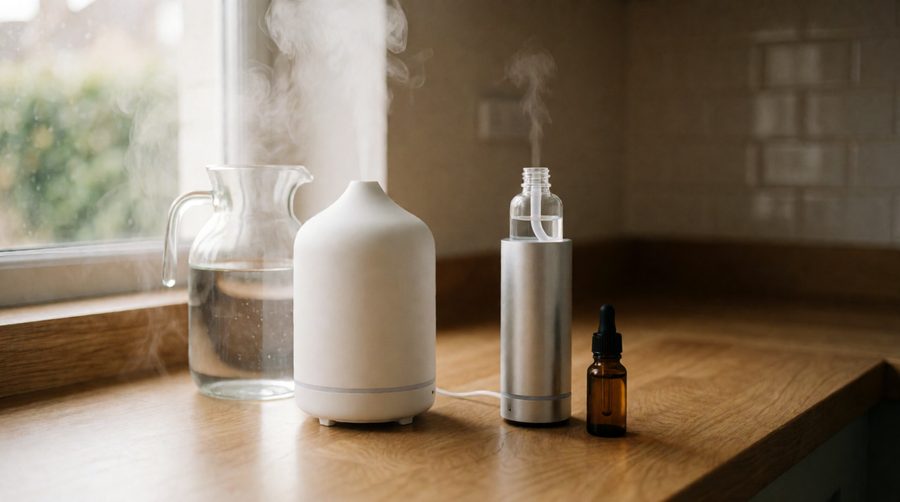
Coverage is quoted in square feet, square metres or cubic metres, usually at the highest setting. For scale, a new-build double bedroom in England must be at least 11.5 m² (about 124 sq ft) under the government's nationally described space standard, so a model rated for 300-500 sq ft covers most bedrooms with room to spare. A plug-in or compact pod handles one room; for open-plan spaces or a whole floor, look at a scent air machine rated for 1,000 sq ft upwards.

Mains units can run all day on a schedule. Rechargeable ones can go anywhere, from the bathroom to a car cup holder; NEOM, for example, quotes up to 125 hours per charge for its Wellbeing Pod Mini+, depending on the setting.

Check this before you buy. Some brands design their diffusers around their own bottles or cartridges and advise against other oils; NEOM, for example, recommends only its own blends for the Pod Mini+. Others accept any pure essential oil or fragrance oil in a standard bottle, which keeps running costs down. Avoid models that tie you to a subscription unless you love the brand's scents.
Waterless models work in short bursts: a few seconds on, a few minutes off. Look for adjustable intensity and auto shut-off, and, if you want the scent waiting when you get home, app scheduling. Our smart diffusers and diffusers with a timer let you set start times, not just switch-off times.
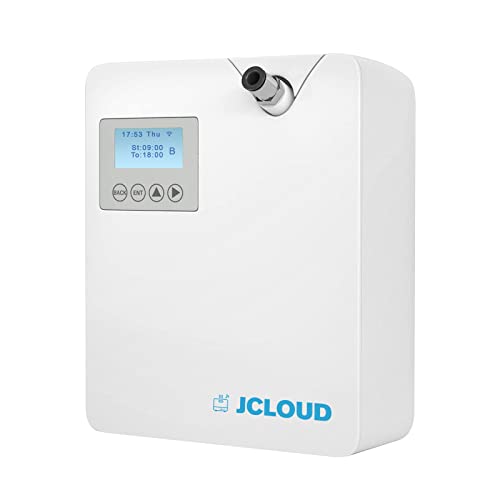
The pump gives a soft hum. Compact models are typically very quiet; larger scent air machines can be closer to a fridge. For a bedroom, pick a model with a night mode or run it before bed on a timer.
Larger reservoirs mean fewer refills. Jcloud, for instance, quotes under 0.5ml an hour for its P300, which is why a 300ml bottle can last weeks on a moderate cycle. If you want to compare a few models from one maker, see our Jcloud diffuser range.
If you are starting out, our essential oil diffuser sets give you several scents to try without buying full-size bottles of each.
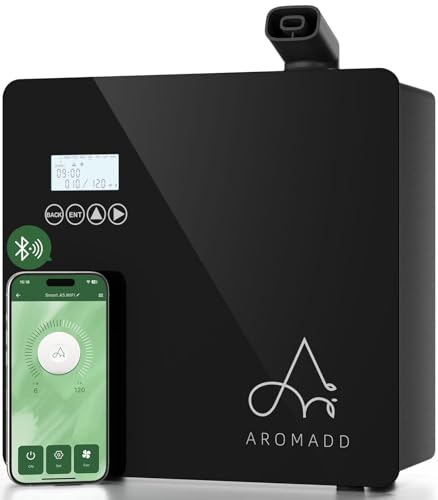
Once you need scent across several rooms, a waterless essential oil diffuser in a larger format makes sense. Floor-standing and wall-mounted machines hold 500ml-1,500ml of oil, and many connect to air-handling ducts. See our HVAC scent diffusers, or for shops, gyms and reception areas, a commercial scent machine.
Undiluted oil makes the scent strong, so take care around animals. Cats are especially sensitive: oils such as tea tree, peppermint, eucalyptus, citrus and ylang ylang can harm them. Read Cats Protection on essential oils and the PDSA guidance on cats and essential oils, keep pets out of the room while you diffuse, and air it afterwards.
Scent can also trigger symptoms in people with asthma or other lung conditions. Asthma + Lung UK reports that 4 in 10 people it surveyed said aerosols and perfumes triggered their condition, so keep sessions short, ventilate the room and stop if anyone feels wheezy. On the plus side, a waterless model adds no damp to the air and, unlike a scented candle, has no flame.
Yes, usually. They atomise neat oil rather than a few drops in water. Short on/off cycles, low intensity and timers keep consumption sensible, and the stronger scent means you need less time running.
No. Water won't atomise properly and can damage the pump and nozzle. If you want mist and humidity, choose an ultrasonic model instead.
Use the auto shut-off or timer rather than leaving one running unattended for hours, and keep it out of reach of children and pets.
In most cold air machines and many pods, yes. Some nebulisers are designed for pure essential oils only, so check the manual.
Yes. A compact rechargeable model that fits a cup holder has nothing to spill. Keep the intensity low so the scent isn't distracting while you drive.
A cold air scent air machine with a 300ml or larger bottle and a coverage rating comfortably above your floor area. Compact pods are designed for small spaces.