Our product rankings are based on analysis of thousands of customer reviews, brand reputation, pricing trends, and popularity data. They represent our honest opinion and are intended as a helpful starting point for your research. Some links on this site are affiliate links — if you buy through them, we may earn a small commission at no extra cost to you. This helps us keep the site free and up to date.
A cold air diffuser is a waterless scent diffuser that uses a small air pump and an atomising nozzle to break oil into particles so fine they hang in the air as an almost invisible, dry mist. Nothing is heated and nothing is mixed with water, so the oil reaches the room as it came out of the bottle.
You will see the same idea sold under several names: cold-air diffusion, scent air machine, cold air oil diffuser, dry mist diffuser and aroma diffuser. Some listings even say cool air diffuser or cold diffuser. They all describe the same method. What separates one model from another is the size of the bottle, how much space it is built to scent, and how you control it.
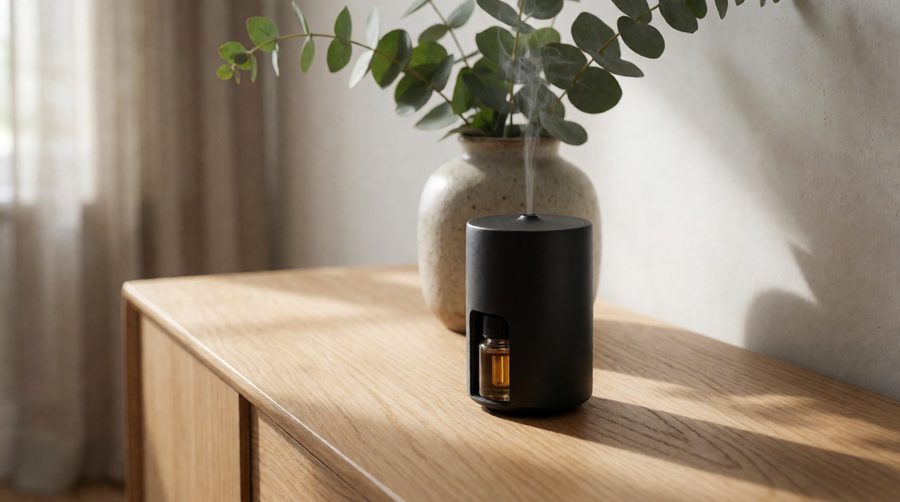
The principle is simple physics. A pump pushes a fast stream of air through a narrow channel past the top of a tube that dips into the oil. Fast-moving air has lower pressure (the Venturi effect, an application of Bernoulli's principle), so the oil is drawn up the tube and shredded into tiny droplets where it meets the airstream. This is called two-fluid atomisation, because two fluids, air and oil, meet in the nozzle.
Many machines then pass the spray through a small chamber where the heavier droplets fall back into the bottle and only the finest particles escape. Manufacturers typically quote particles of around 1 to 5 microns. Because they are so light they stay airborne and spread through the room rather than settling as an oily film on furniture.
The other defining feature is the work/pause cycle. Rather than running continuously, a cold air machine diffuses for a few seconds, rests, then diffuses again, for example 10 seconds on and 120 seconds off. Changing that ratio is how you raise or lower the intensity, and it is why a single bottle can last weeks.
The terms overlap, which is why so many people search for the difference. In short:
| Cold air diffuser | Classic nebuliser | Ultrasonic | Heat / plug-in warmer | |
|---|---|---|---|---|
| How it works | Air pump + two-fluid nozzle, work/pause cycles | Air pump atomises neat oil, often continuous | Vibrating plate turns water and oil into mist | Gently warms oil or wax so it evaporates |
| Water | None | None | Yes, tank | None |
| Heat | None | None | None | Yes |
| Mist | Dry, near invisible | Fine, visible close up | Visible, damp | None |
| Oils | Fragrance oils and thin essential oils | Pure essential oils | A few drops of essential oil | Oils or wax melts |
| Typical coverage | One room to a whole house | One room | Bedroom or small room | Small room |
| Upkeep | Swap bottle, clean nozzle occasionally | Clean glass with alcohol | Empty, rinse and descale tank | Wipe dish |
Bottles of roughly 60-200ml, sized for a living room, bedroom or open-plan kitchen. Most connect to an app over Bluetooth.

A slim unit fixed to a wall near the front door or on a landing keeps the oil out of reach of children and pets and scents the circulation space that links every room.
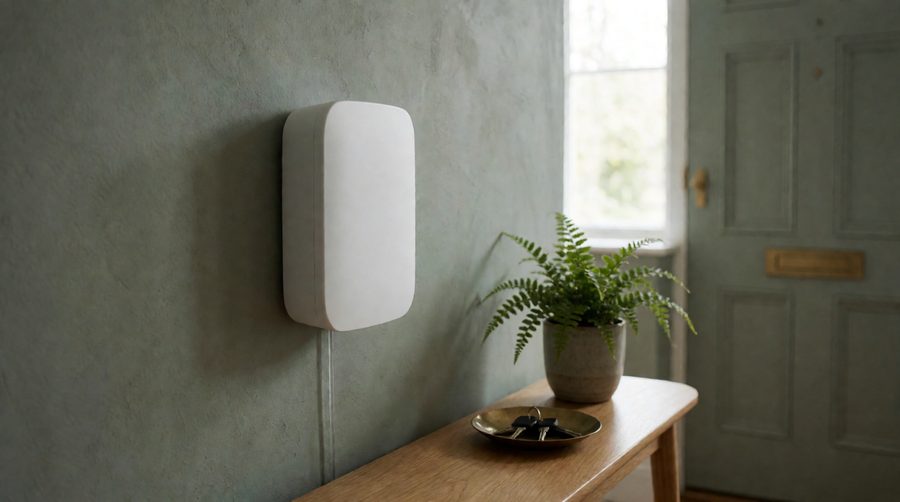
Larger machines connect to ducted heating or ventilation so the scent travels through the vents into every room. That is common in hotels and offices; in UK homes it works with mechanical ventilation or ducted air conditioning. Our HVAC scent diffuser page explains the fittings.

Tall units with 500-1,500ml bottles for shops, gyms, receptions and large open-plan homes. For whole-floor business scenting, compare a commercial scent machine.
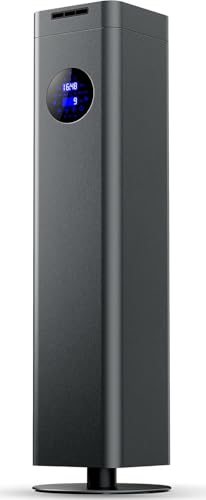
Coverage is usually quoted in square feet; divide by 10.76 for square metres. A 1,000 sq ft rating is about 93 m², which is a whole floor of many UK houses rather than one room. Ratings assume a high setting and closed doors, so buy for the space you actually want to scent, then turn it down. For big open spaces, browse our large room diffusers.
Running cost depends on the cycle setting. Aromaplan, for example, quotes a usage rate of about 1ml an hour for its oils. One cold air brand's guide estimates that a 120ml bottle lasts 8-12 weeks at moderate intensity for 6-8 hours a day. Bigger bottles mean fewer refills, not stronger scent.

Check whether the machine takes any oil or only the brand's own. Thin, alcohol-free fragrance oils and pure essential oils work best. Thick oils like vetiver, sandalwood and myrrh, and anything blended with a carrier oil such as coconut or jojoba, clog the nozzle. Our Aromaplan diffuser range comes with oils made to match.
Basic models have buttons and a few preset levels. App-controlled models let you set different schedules for weekdays and weekends and adjust the work/pause ratio to the second. If you want that, look at a smart diffuser; if you only need it to switch off on its own, a diffuser with timer is enough.
Put it at chest height or higher, away from radiators and direct sunlight, and near the flow of air through the room, such as a doorway or hallway. Keep it off polished wood if the nozzle points sideways.
Most cold air machines handle essential oils, provided they are thin and pure. Citrus, lavender, eucalyptus, peppermint and tea tree diffuse well; resinous and woody oils are better left to a classic nebuliser. Start with a short work cycle and a long pause, live with it for a day, then adjust. Your nose stops noticing a constant scent quickly, so a gentle cycle is more pleasant than a strong one. If you want to try several blends, our essential oil sets are an easy way to start.
Scented oils release volatile organic compounds (VOCs). The UK's indoor air quality guidelines for VOCs include D-limonene, the main compound in citrus oils, so moderation and ventilation matter even with natural oils. Asthma + Lung UK notes that air fresheners and scented products can make lung condition symptoms worse, so anyone with asthma should keep the setting low, use cycles rather than constant scent, and stop if it causes symptoms.
Many oils, including tea tree, peppermint, eucalyptus and citrus, are a risk to cats. Cats Protection advises keeping cats out of rooms where oils are diffused and airing the room before they return. A wall-mounted unit in a hallway, with doors that let cats move away from the scent, is a sensible set-up in a home with pets.
Every cold air diffuser is waterless, but not every waterless diffuser uses cold air. Plug-in warmers and some pods are waterless but use heat or a fan.
For larger spaces and a steady background scent, usually yes. For a bedroom, a low budget or if you like a visible mist, an ultrasonic diffuser is cheaper and uses less oil.
Yes, in most models, as long as the oil is thin and undiluted. Avoid thick oils and carrier oil blends, and check whether the brand restricts you to its own bottles.
Less than you might expect. Because it runs in short bursts, a 120ml bottle can last a couple of months on a moderate setting. Higher intensity and longer schedules use more.
Yes, that is what they are designed for, but use a schedule so it isn't scenting an empty house, and give the room a break overnight.
No. "Cool mist" normally describes an ultrasonic diffuser with a water tank. A cold air diffuser has no water at all.
Convert your floor area to square feet (m² x 10.76) and choose a model rated a little above it. For a hotel-style scent through a whole house, a wall or hotel scent diffuser sized for 1,500 sq ft or more is a good starting point.