Our product rankings are based on analysis of thousands of customer reviews, brand reputation, pricing trends, and popularity data. They represent our honest opinion and are intended as a helpful starting point for your research. Some links on this site are affiliate links — if you buy through them, we may earn a small commission at no extra cost to you. This helps us keep the site free and up to date.
A nebulizing diffuser (often spelt nebulising diffuser in the UK, and sold as an essential oil nebulizer or diffuser nebuliser) is a waterless essential oil diffuser that breaks neat oil into tiny particles and releases them into the room. Nothing is mixed with water and nothing is heated, so what you smell is the oil itself, at full strength.
That sets it apart from the ultrasonic diffusers most people start with. An ultrasonic model floats a few drops of oil on a tank of water and vibrates it into a visible mist. A nebulizing essential oil diffuser skips the water, so the aroma is more concentrated, it reaches further and it adds no humidity to the air. The trade-off is that it uses more oil and the air pump makes a faint hum.
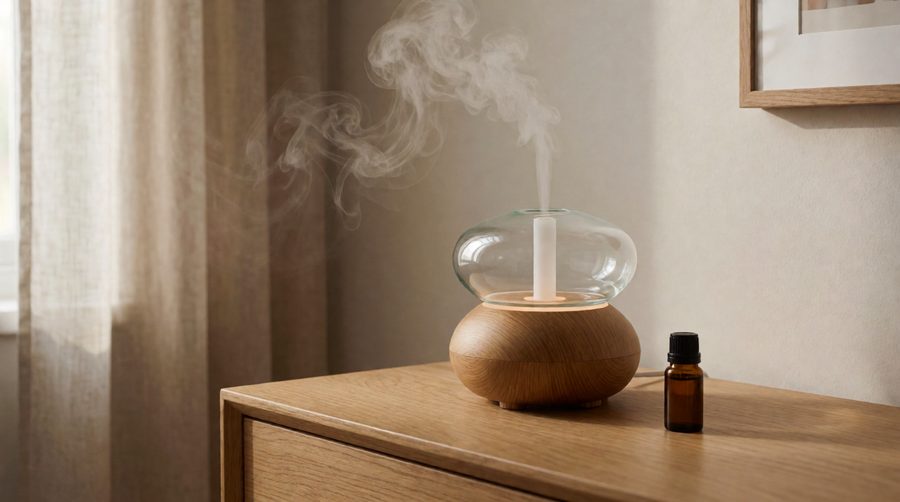
Inside the base is a small air pump. It pushes a fast stream of air across the top of a narrow tube that dips into the oil. Fast-moving air creates low pressure (Bernoulli's principle, the same effect a carburettor uses), which draws oil up the tube. When the oil meets the air jet it is sheared into droplets of roughly 1-5 microns and carried out as a dry, almost invisible vapour. Organic Aromas explains the process in detail.
There are two common layouts:
Nearly all models run in short bursts, for example 2 minutes on and 1 minute off, because continuous diffusion would quickly overwhelm a room and burn through oil.
| Nebuliser | Ultrasonic | Cold air | |
|---|---|---|---|
| How it works | Air pump draws up and atomises neat oil | Vibrating plate turns water and oil into mist | Pressurised air atomises oil from a bottle, usually on a schedule |
| Water needed | No | Yes | No |
| Scent strength | Strong, pure | Light (oil diluted) | Even, steady |
| Oil use | Highest | Lowest | Moderate |
| Humidity | None | Adds some | None |
| Noise | Soft pump hum | Near silent | Low hum |
| Typical coverage | One room to an open-plan floor | Bedroom or small room | Room to whole house |
| Upkeep | Clean nozzle or glass with alcohol | Empty, rinse and descale the tank | Change the bottle, occasional nozzle clean |
Cold air machines use the same atomising idea but are tuned for fragrance oils and long schedules, which is why hotels use them. If that is what you are after, see our cold air diffusers. For any design that avoids a tank, our waterless diffuser range is the place to start.
A portable diffuser built on nebulising technology is a good fit for hotel rooms, caravans, the car and the desk, because there is no water to spill. Most are a small cylinder with a rechargeable battery and a screw-in bottle underneath. Run time varies widely: NEOM quotes up to 125 hours per charge for its Wellbeing Pod Mini+ on lighter settings, and Organic Aromas lists 16-20 hours per charge (with a 4-5 hour charge) for its Smart Mobile Mini. Always check the figure for the setting you will actually use.
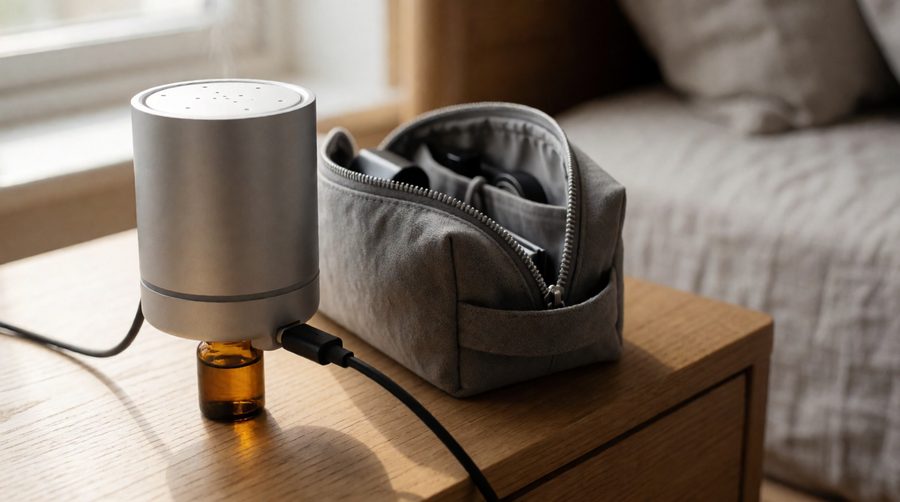
When choosing a travel diffuser, look for USB-C charging, a lid or seal for the bottle, a car mode with a lower intensity and an auto shut-off timer. Our battery operated diffuser range covers cordless models in detail, and the Ceeniu car diffusers are designed to sit in a cup holder. Treat the lithium-ion battery like a phone's: charge on a hard surface with a decent charger and stop using it if it swells or overheats, as the London Fire Brigade advises.
Coverage is usually quoted in square feet. As a rough guide, 300-500 sq ft (28-46 m²) suits a bedroom or office, 1,000 sq ft (93 m²) a large living room, and 1,500 sq ft (139 m²) or more an open-plan ground floor. Puressentiel, for example, rates its VERA nebuliser at about 60 m² on low and up to 120 m² on high. For big spaces, compare our large room diffusers.

A glass reservoir lets you use any brand of oil and blend your own, a few drops at a time. A screw-in bottle is tidier and better for travel, but check whether the unit takes standard bottles or only the maker's own. If you love the look of glass, our glass diffusers are worth a browse.
Intermittent cycles keep scent at a pleasant level and stretch your oil. Florame's nebuliser, for instance, runs 2 minutes on and 1 minute off on its gentle setting and 15 minutes on and 30 off on its strong one, then switches off after an hour. If you want it to come on before you get home or switch off as you sleep, choose a diffuser with a timer.
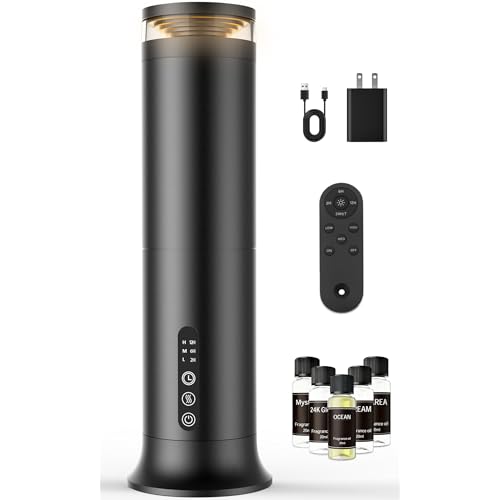
Every nebuliser has a pump, so expect a soft hum, more noticeable on high and on hard surfaces. Look for a decibel rating under about 40dB for a bedroom, and see our quiet diffusers if silence matters most.
Basic models have a single dial. Smarter ones add a remote, scheduling and app control over Bluetooth or Wi-Fi, which is handy when the diffuser sits high on a shelf. Our smart diffusers cover the app-controlled options.

Mains or USB-powered models suit all-day use at home. Battery models trade run time for freedom to move. For shops, salons and receptions, a commercial scent machine with a large bottle is more economical than a home unit.
Thin, pure essential oils such as lavender, eucalyptus, peppermint, sweet orange, lemon, bergamot, tea tree and rosemary nebulise easily. Thick or resinous oils, including vetiver, patchouli, myrrh, benzoin, sandalwood and some frankincense, struggle to climb the tube and leave a sticky residue that can block it. Use them sparingly in a blend with a thinner oil. Never add carrier oils such as sweet almond or jojoba, and only use fragrance oils if the manufacturer says the diffuser can take them. Our essential oil diffuser sets are an easy way to try several suitable scents.

Because a nebuliser releases undiluted oil, it is stronger than people expect. Keep sessions short, leave a door or window open, and stop if anyone gets a headache or feels wheezy. Asthma + Lung UK notes that many scented and household products release VOCs that can make lung symptoms worse, and recommends keeping rooms well aired. Puressentiel advises against diffusing around children under 7 without professional advice.
Pets need extra care. Many oils, including tea tree, peppermint, eucalyptus and citrus, can be harmful to cats, and Cats Protection advises keeping cats out of rooms where oils are being diffused. Use the diffuser in a room your pets don't use, and air it before they return.
It is stronger and keeps the oil pure, with no water to change. An ultrasonic diffuser is quieter, cheaper to run and adds a little humidity. Choose a nebuliser for scent strength, ultrasonic for gentle background aroma.
Yes. Nebulising is the British spelling, nebulizing the American one. A diffuser nebuliser, essential oil nebulizer and nebulising diffuser all describe the same waterless technology.
More than ultrasonic models, because the oil isn't diluted. Intermittent cycles, low settings and timers keep consumption sensible; some compact models quote under 1ml an hour.
They hum quietly from the air pump. Most people don't notice it in a living room, but light sleepers should pick a model with a low decibel rating and a timer.
Only if the manufacturer allows it. Many nebulisers are designed for pure essential oils, and thicker fragrance blends can clog the nozzle or tube.
Yes, a waterless model is ideal because nothing can spill. Use the lowest setting or a car mode so the scent never becomes distracting.
Short sessions work best: 15-30 minutes, or a cycle mode with an automatic shut-off after one to two hours, then a break.
Compact units suit around 500 sq ft; mid-sized home models 1,000-1,500 sq ft; larger machines can scent several thousand square feet, often via the ventilation system.