Our product rankings are based on analysis of thousands of customer reviews, brand reputation, pricing trends, and popularity data. They represent our honest opinion and are intended as a helpful starting point for your research. Some links on this site are affiliate links — if you buy through them, we may earn a small commission at no extra cost to you. This helps us keep the site free and up to date.
A hotel scent diffuser is a waterless, cold-air machine built to spread fragrance evenly through a large space for hours at a time. Instead of a water tank and an ultrasonic plate, it pushes air through a small atomiser (a nebuliser) that breaks fragrance oil into particles fine enough to hang in the air rather than settle on surfaces. There is no heat, so the oil isn't "cooked", and no water, so there is no damp or mould to worry about.
They are popular in hospitality because they are consistent. A lobby smells the same at 7am as it does at 11pm, because the machine runs on a schedule with set spray and pause times. That same technology now comes in home-sized versions, which is why "hotel diffuser for home" has become its own category.
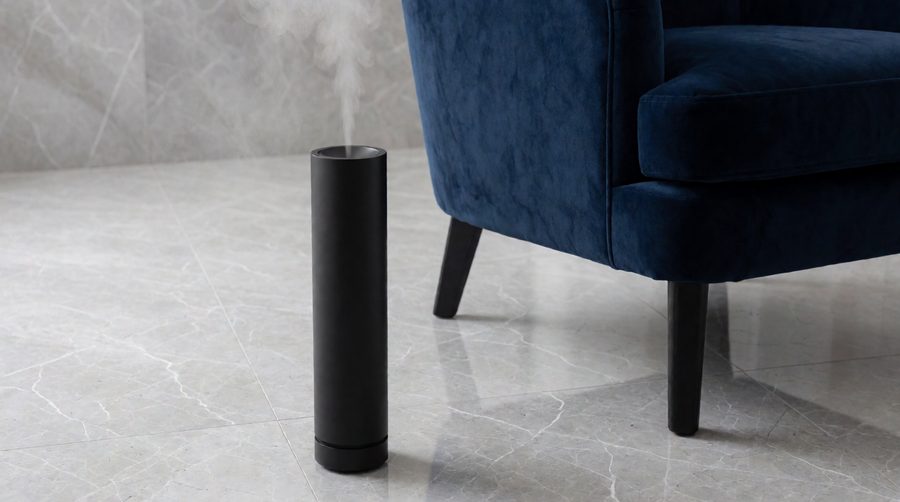
Hotel scent diffusion is a form of sensory branding: a property chooses one fragrance and uses it everywhere, from the entrance to the spa, so guests link that smell with the brand. Westin is the best-known example. Its White Tea blend has filled its lobbies for years and is now sold for home use. Westin is one of the brands ScentAir features in its case studies, alongside Mandalay Bay in Las Vegas, where a Coconut Spice aroma runs through the existing HVAC across the hotel and a 135,000 sq ft casino. Our ScentAir diffuser page covers the brand's smaller units. The Langham, whose flagship is in London, uses a custom Ginger Flower fragrance created by Air Aroma, and Air Aroma notes it was among the first hotels to adopt a brand-standard fragrance. EDITION worked with Le Labo on theirs.
Many of these brands now sell their own oil and diffusers, and a large market of "inspired by" oils has grown up around them. Those are interpretations, not the original formulas, so treat the name as a guide to the style rather than a promise.
| Brand | Signature fragrance | Key notes | Style |
|---|---|---|---|
| Westin | White Tea | White tea, aloe, cedarwood | Clean, spa-like |
| The Langham | Ginger Flower | Ginger flower, jasmine, lily of the valley, green notes | Fresh floral |
| EDITION | Le Labo collaboration | Black tea, bergamot | Warm, understated |
| "Lobby" blends in general | Various | White tea, fig, bergamot, sandalwood, amber | Fresh top, woody base |
For a house or flat, the goal is a hallway or open-plan living space that smells like a boutique stay when you walk in. A compact unit covering 500-1,500 sq ft (roughly 45-140m²) is usually enough for a ground floor. Pair it with a lobby-style oil and run it on a schedule: on in the morning and when you get home, off overnight. If you want the whole house covered by one machine, a model that connects to ducted air is an option, though ducted heating and ventilation is less common in UK homes than in the US.
For a business, coverage, reliability and control matter more than looks. A scent diffuser for a hotel lobby needs a large oil reservoir (300-1,000ml), adjustable work and pause cycles, scheduling for opening hours and ideally app control so staff don't need to reach the unit. Bigger venues tie the system into the ventilation so the fragrance travels through corridors and floors; that's what our HVAC scent diffuser range is for. For a single large lobby, restaurant or showroom, a standalone commercial scent machine is simpler to install.

| Reed | Ultrasonic | Cold-air (nebulising) | HVAC | |
|---|---|---|---|---|
| How it works | Oil wicks up sticks | Water + oil turned to mist | Neat oil atomised by air | Cold-air unit feeding ductwork |
| Typical coverage | A small room | One room | 500-6,000 sq ft | Whole floors or buildings |
| Strength | Gentle | Light to medium | Strong and even | Even throughout |
| Control | None | Basic timer | Spray/pause cycles, app | Spray/pause cycles, app |
| Best for | Bathrooms, side tables | Bedrooms | Hallways, living rooms, lobbies | Hotels, large homes with ducted air |
Most of what we list here is cold-air. For the wider range, browse our waterless diffusers and cold air diffusers.
Coverage claims are usually in square feet, sometimes in cubic metres. As a rule of thumb, 1,000 sq ft is about 93m². A cubic metre figure includes ceiling height, so 1,500m³ with a 2.5m ceiling is roughly 600m² of floor. Claims assume open space and a high setting; walls, doors and draughts cut them down, so buy a little more coverage than you think you need. For big open-plan rooms, see our large room diffusers.
This is where most buyers get caught out. Some branded units only take their own screw-in bottles, and some are sold on a refill subscription. Before you buy, check whether the unit accepts any fragrance oil or only the maker's cartridges, and work out the cost per month at your setting.

Makers quote consumption in ml per hour of spraying. Aromaplan, for example, rates its oils at about 1ml per hour, so its 473ml Santal bottle is listed at around 450 hours. Larger commercial units use far more: the CONTIA L065 is rated at 4-6ml per hour of spraying. Pause cycles stretch this a long way, which is why a lobby unit can run for weeks on one bottle.
A good model lets you set when it runs, how long each spray lasts and how long it pauses. Scenting only during opening hours or when you are home saves oil and stops the room becoming overpowering. Our diffusers with a timer and smart diffusers handle this from your phone.
Cold-air pumps hum. In a lobby that's lost in the background, but next to a bed it matters. Look for a dB figure (under 40dB is quiet) or browse our quiet diffusers.

The best hotel diffuser scents for home are usually clean rather than sweet: white tea, fig, bergamot, cedar and sandalwood, often with a soft amber or musk base. These smell fresh in daytime and don't feel heavy in a small room. Bright citrus works in kitchens; deeper woods and leather suit living rooms in winter.

Look for oils made for cold-air machines, as thick oils and blends with carrier oil can clog the nozzle. Pure essential oils work but are less long-lasting than fragrance oils designed for nebulisers. To try several before committing to a big bottle, an essential oil diffuser set is a cheaper start, and our Aromaplan diffuser page covers a brand known for hotel-style blends.
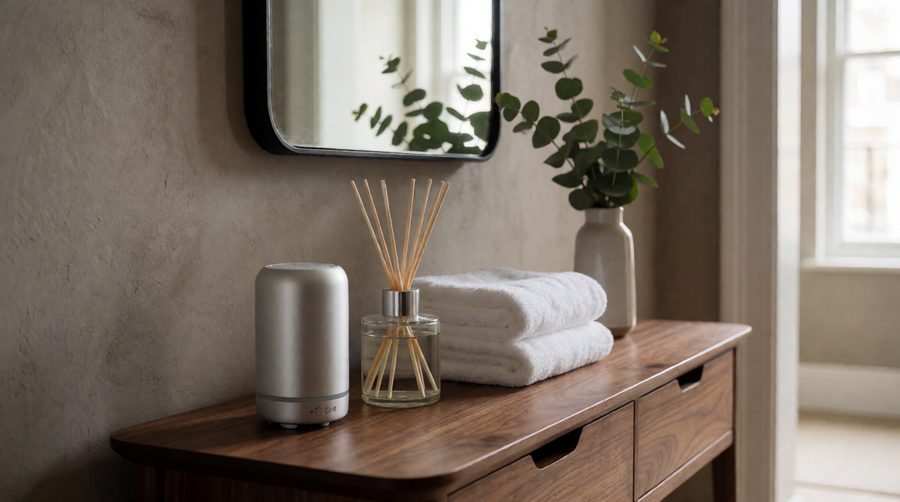
Fragrance affects people differently. Asthma + Lung UK advises picking unscented products where possible and using sprays in a well-aired space; see its guide to improving indoor air quality. If anyone at home has asthma, keep the setting low and the room ventilated. In a business, a light fragrance in public areas is easier to manage than perfuming guest rooms.
Many essential oils, including tea tree, citrus, peppermint and eucalyptus, can harm cats in particular, and fragrance oils are a mix of chemicals too. Read Cats Protection on essential oils before diffusing around pets, and keep animals out of the room while it runs.
Most large hotels use commercial cold-air systems from specialists such as ScentAir or Air Aroma, either standalone towers in the lobby or units linked to the HVAC. Smaller venues often use a standalone cold-air machine with a 500ml-1,000ml bottle.
Yes. Home-sized cold-air models use the same nebulising method on a smaller scale. A unit covering 500-1,500 sq ft suits most hallways and open-plan ground floors.
Use one consistent fragrance in your entrance and main living space, run a cold-air unit on a schedule, and pick a clean blend such as white tea, fig or bergamot with a woody base. Keep it light so it reads as fresh rather than perfumed.
Not always. Some branded units only take their own bottles. Open-bottle models accept most fragrance oils, but avoid thick oils, carrier oils and anything containing water.
It depends on the machine and settings. At around 1ml per hour of spraying, a 120ml bottle gives about 120 hours of spray time, and with pause cycles that can be several weeks of daily use.
Use them with care. Cats are especially sensitive to many oils. Keep the setting low, ventilate the room and keep pets out of that room.